
Qt GRPC Interceptors Overview
Interceptors overview
Client-side interceptors provide a lightweight mechanism for implementing behavior that should apply consistently across many RPCs. They are especially useful for cross-cutting concerns that are independent of a specific RPC method, such as:
- Distributed tracing
- Logging
- Authentication and authorization
- Metrics and observability
- Policy enforcement
- Client-side caching
- Fault injection
Interceptors are installed on a channel using a QGrpcInterceptorChain. Each interceptor implements one or more interceptor interfaces (for example QGrpcStartInterceptor and QGrpcFinishedInterceptor). The Qt GRPC channel invokes the corresponding interface whenever that stage of an RPC is reached, providing the context of the current RPC.
Interceptors operate at the level of individual RPCs. They can inspect and modify request or response metadata and payloads as the RPC progresses. They are intended for implementing per-call behavior rather than managing channel or transport configuration.
Note: Interceptors in Qt GRPC are installed on a channel and apply to all RPCs performed through that channel. The interceptor chain is fixed at construction time and cannot be modified afterwards. To change the interception behavior, create a new channel with a different interceptor chain.
Capabilities and hook points
Each interception interface represents a hook point in the RPC lifetime. An interceptor class can implement multiple interfaces by using multiple inheritance.
Qt GRPC detects which interception interfaces an interceptor implements and exposes them as capabilities. Qt GRPC uses these capabilities to dispatch only the hooks that are actually implemented.
| Interface | Hook Point | Direction | Can Modify |
|---|---|---|---|
| QGrpcStartInterceptor | Before the RPC is initiated | Outbound | Initial message object, call options |
| QGrpcWriteMessageInterceptor | Before an outgoing message is written | Outbound | Message object |
| QGrpcWritesDoneInterceptor | When the client indicates writes are done | Outbound | — |
| QGrpcCancelInterceptor | When the RPC is cancelled | Outbound | — |
| QGrpcInitialMetadataInterceptor | When initial metadata is received | Inbound | Metadata |
| QGrpcMessageReceivedInterceptor | When a message payload is received | Inbound | Serialized message data |
| QGrpcTrailingMetadataInterceptor | When trailing metadata is received | Inbound | Metadata |
| QGrpcFinishedInterceptor | When the RPC completes | Inbound | Final status |
All callbacks receive a QGrpcInterceptionContext, which provides information about the intercepted RPC, such as the RPC descriptor, the channel or the callOptions in effect. The context object is only valid for the duration of the callback and must not be used afterwards.
Note: Keep interception logic lightweight and avoid blocking operations in callbacks. Perform slow work (for example I/O or token refresh) outside the callback and only apply the result in the hook.
Direction and flow
When multiple interceptors are used, their order is significant. It is useful to think of interceptors as arranged in a line between the application and the network. Interceptors earlier in the chain process the RPC first and may modify it before passing it to the next interceptor. Interceptors closer to the network have the last chance to observe or adjust what is actually sent.
Interceptors are added to a QGrpcInterceptorChain in a defined order. QtGrpc traverses the chain as the RPC flows:
- For outbound stages (application → network), callbacks are invoked in the order in which interceptors were added to the chain.
- For inbound stages (network → application), callbacks are invoked in the reverse order so that the last interceptor “closest to the network” sees inbound data first.
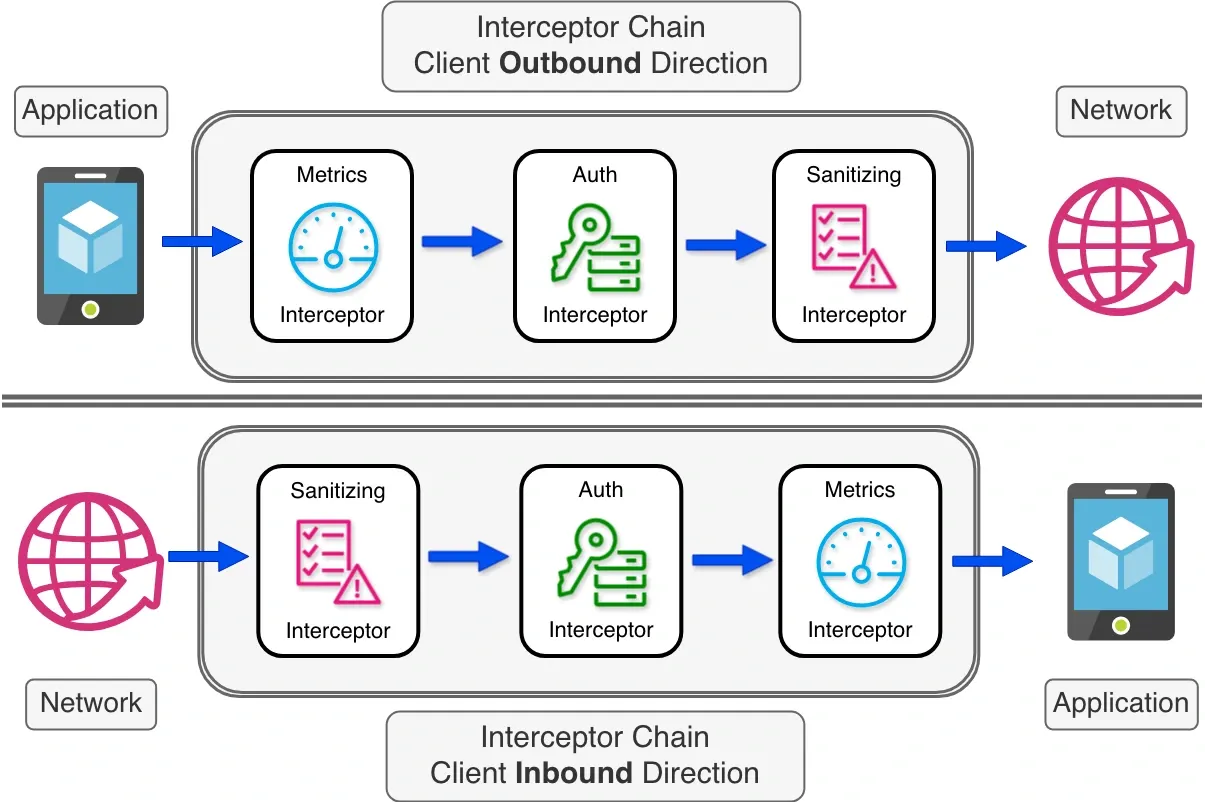
Outbound stages correspond to operations initiated by the client, such as sending a message or completing a write sequence (for example, writeMessage or writesDone). These events travel from the application through the interceptor chain toward the network.
Inbound stages correspond to events produced by the RPC, such as receiving a message or the completion of the call (for example, messageReceived or finished). These events travel from the network back through the interceptor chain toward the application.
Ownership and lifetime
QGrpcInterceptorChain supports two primary lifetime models:
- Owning: Add interceptors using
std::unique_ptr<T>(). On success, the chain takes ownership and destroys the interceptors when the chain (and therefore the channel) is destroyed. - Non-owning: Add interceptors using raw pointers
T*. The chain does not take ownership. The caller must ensure that interceptor objects remain valid for as long as the channel may invoke them.
Both models can also be combined within the same chain. While supported, mixing owning and non-owning interceptors requires care to ensure that non-owning interceptors outlive all channels that may use them.
Non-owning interceptors can be shared between multiple channels by adding the same interceptor instance to multiple chains. This is useful for shared logging or shared metrics collection, but it requires careful management of lifetime and concurrent access.
Thread safety and shared state
Interceptor callbacks run in the thread of the channel that owns the interceptor chain.
Reentrant interceptors do not require any synchronization.
Synchronization is only required when interceptors access shared data that may be used from multiple threads. This can occur, for example, when the same interceptor instance is used by channels living in different threads, or when multiple interceptor instances access the same shared data.
When shared data must be accessed across threads, prefer keeping interceptor instances thread-local and storing the shared data in a separately synchronized object.
struct SharedData
{
    QReadWriteLock lock;
    // shared data protected by lock
};

class MyInterceptor : public QGrpcStartInterceptor
{
public:
    explicit MyInterceptor(std::shared_ptr<SharedData> data)
        : m_sharedData(std::move(data)) {}

    Continuation onStart(~~~) override; {
        // access shared data here
    }

private:
    std::shared_ptr<SharedData> m_sharedData;
};
~~~
auto sharedData = std::make_shared<SharedData>();
bool ok = chain1.set(
    std::make_unique<MyInterceptor>(sharedData),
    std::make_unique<MyInterceptor>(sharedData)
);
// repeats for chain2
~~~
auto channelThread1 = std::make_shared<QGrpcHttp2Channel>(
    QUrl("address:port"), std::move(chain1));
auto channelThread2 = std::make_shared<QGrpcHttp2Channel>(
    QUrl("address:port"), std::move(chain2));
© 2026 The Qt Company Ltd. Documentation contributions included herein are the copyrights of their respective owners. The documentation provided herein is licensed under the terms of the GNU Free Documentation License version 1.3 as published by the Free Software Foundation. Qt and respective logos are trademarks of The Qt Company Ltd. in Finland and/or other countries worldwide. All other trademarks are property of their respective owners.
