
Multimedia Security Considerations
Data Flow Diagram
The diagram shows high-level data-processing elements in Qt Multimedia that contribute to secure handling of untrusted media sources.
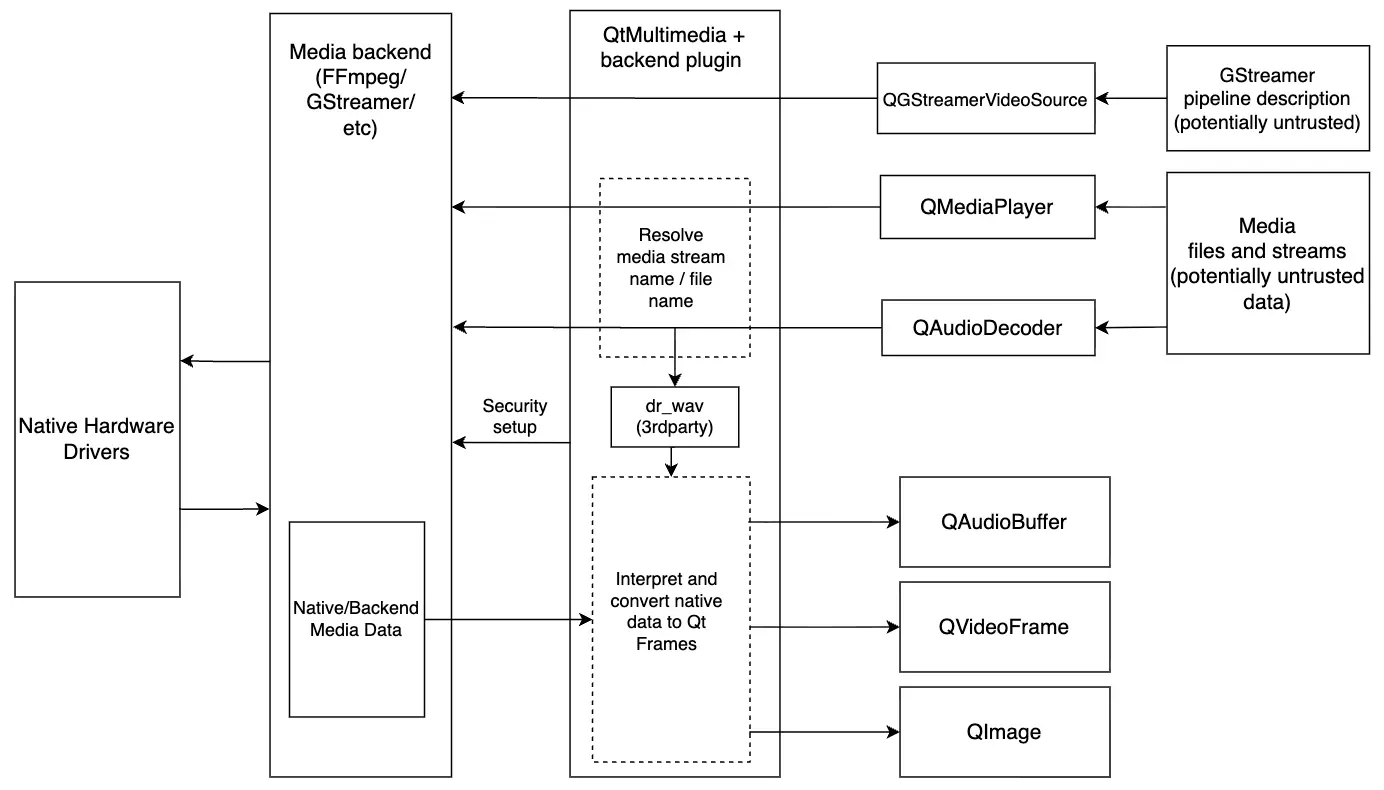
Assumptions
Like the rest of Qt, Qt Multimedia assumes that the environment it runs in is correctly configured and has not been compromised. In particular, the process environment, the search paths from which libraries and plugins are loaded, and the installed hardware-decoding drivers are assumed to be controlled by whoever deploys the application, and not by an attacker. Attacks that require an already insecure process environment fall outside the scope of Qt's security responsibility, as described in Qt Shared Security Model.
The media content itself is not covered by that assumption. Media data, and the URLs that refer to it, are treated as untrusted input, and are the subject of the rest of this page. See also Handling Untrusted Data.
Some of the points below are therefore listed not because Qt Multimedia defends against them, but because they are the responsibility of the application developer and need to be accounted for when an application is deployed.
Risks
In theory, if an application allows users to play untrusted media sources and an attacker is aware of a vulnerability in any element shown in the figure above, they may craft a media source that triggers the vulnerability and provide it to the application in the intended manner.
The risks below are grouped by who is responsible for addressing them, following the roles defined in Qt Shared Security Model.
Risks addressed by Qt
- Vulnerabilities in third-party libraries shipped with Qt Multimedia. Qt Multimedia does not attempt to contain a compromised third-party library, so keeping those libraries up to date is what protects the application. We track vulnerabilities reported against the libraries we ship, update them as patch releases become available, and report the defects we find ourselves to the upstream projects.
- Flaws in Qt Multimedia's own data flow elements that may result in undefined behavior. The most sensitive area is data layout processing of native and backend media frames. We follow established secure coding practices, cover this code with manual and automated tests, and fuzz test Qt Multimedia internally to find defects that those tests do not reach.
Risks addressed by the application developer
- Several Qt Multimedia APIs take a URL as their source or destination, and perform file system or network access on the application's behalf. This includes QMediaPlayer::setSource, QAudioDecoder::setSource, QSoundEffect::setSource, and QMediaRecorder::setOutputLocation. Passing an unvalidated URL to these APIs therefore lets whoever controls that URL decide which files are read or written, and which hosts are contacted.
- With the GStreamer media backend, passing a malicious custom GStreamer pipeline description to QGStreamerVideoSource or QMediaPlayer. We highly recommend never running an untrusted GStreamer media pipeline with Qt Multimedia unless you can meaningfully preprocess and validate GStreamer pipeline descriptions.
- A media backend is only used if its plugin can actually be loaded. The FFmpeg media backend links dynamically against the FFmpeg libraries, so if those binaries are not deployed with the application, or cannot be resolved by the dynamic linker when the plugin is loaded, Qt Multimedia falls back to another available backend without warning. The remaining backends are tried in the order in which their plugins are enumerated, rather than in a documented order of preference, so a deployment mistake can leave the application running on a backend that was never tested for it. If no backend can be loaded at all, only QMediaDevices, QAudioDevice, QSoundEffect, QAudioSink, and QAudioSource remain functional.
- On Android, the FFmpeg media backend verifies
httpsmedia sources against the CA certificates of the application's default trust configuration, but does not otherwise apply the application's Network Security Configuration. Domain-specific trust anchors (<domain-config>), Certificate Transparency requirements, andcleartextTrafficPermitted="false"are ignored for media sources. To prevent cleartext media traffic, accept onlyhttpsURLs and restrict the allowed protocols as described in Configuring allowed network protocols. If the application needs domain-specific trust anchors or Certificate Transparency for its media hosts, it has to download the media itself using an Android network API that applies the Network Security Configuration, and pass the data to QMediaPlayer::setSourceDevice.
Risks that depend on the operating environment
These risks arise from the environment that the application runs in, rather than from Qt Multimedia itself, and Qt Multimedia can neither detect nor prevent them. The application developer needs to account for them when the application is deployed.
- Incorrect environment configuration or hardware-decoding driver setup. Ensure that the environment is configured correctly and that the hardware-decoding drivers are properly installed and up to date.
- Qt Multimedia selects its media backend at runtime, and the selection can be overridden with the
QT_MEDIA_BACKENDenvironment variable, as described in Changing backends. Anyone who can influence the environment of the application process can therefore make the application run on a different media backend than the one it was developed and tested against, with a different set of supported formats and protocols, and a different attack surface.
Impact
Exploitation of the issues listed above may lead to the following security consequences:
- Undefined behavior, practically leading to memory leaks, application crashing, or freezing.
- Remote code execution might be possible whenever an attacker can meaningfully control heap corruption.
- For media formats such as
m3u, which allow different protocols to be used in playlist entries, a wrong setup may allow an attacker to read the file system or contact arbitrary network hosts. By default, potentially dangerous protocols are denylisted, but this behaviour can be changed through any of the following:- Environment configuration. See Configuring allowed network protocols for the FFmpeg media backend.
- GStreamer custom pipeline. See the Qt Multimedia GStreamer backend notes, QGStreamerVideoSource, and the GStreamer pipeline description documentation for details.
- A media backend other than the ones shipped with Qt Multimedia. The media backend is loaded as a plugin at runtime, so a backend plugin found in the application's plugin search paths, or a replaced FFmpeg binary found in its library search paths, applies whichever protocol restrictions it was built with rather than the defaults above.
Note that, depending on the media format, even a valid media source does not necessarily conform strictly to the relevant media standard. There are also many ways in which a source can be corrupted or made invalid. Despite the manual and automated testing performed on Qt Multimedia and third-party libraries by their respective communities, we cannot guarantee correct handling of every single malformed media source. Take this limitation into account when developing applications with advanced security requirements.
Mitigations
- Treat any URL that does not originate from the application itself as untrusted input, and validate it before passing it to Qt Multimedia. Prefer an allowlist of accepted URL schemes and hosts over a denylist of rejected ones. If the application already has the media data, or can obtain it itself, QMediaPlayer::setSourceDevice keeps the application in control of how the data is read.
- Restrict the protocols that the media backend is allowed to use. For the FFmpeg media backend, see Configuring allowed network protocols in Advanced FFmpeg Configuration.
- Control which media backend the deployed application is able to use. Deploying only the media backend plugin that the application needs is the effective control here, because it leaves
QT_MEDIA_BACKENDno other plugin to select. Note that choosing a different default backend does not help on its own:QT_MEDIA_BACKENDtakes precedence over the default, including over a default set with the-default-media-backendconfigure option when Qt Multimedia itself is built from source. - Confirm as part of deployment testing that the application actually runs on the intended media backend. The
qt.multimedia.pluginlogging category reports which backend was loaded, and which plugins failed to load before it. - The Qt Multimedia binaries shipped with the Qt Online Installer are dynamically linked against the FFmpeg libraries
avcodec,avutil,avformat,swscale, andswresample. An application developer or an end user can therefore deploy their own binary-compatible builds of these libraries - that is, builds of the same FFmpeg major version - in order to address FFmpeg vulnerabilities without waiting for a Qt patch release.
© 2026 The Qt Company Ltd. Documentation contributions included herein are the copyrights of their respective owners. The documentation provided herein is licensed under the terms of the GNU Free Documentation License version 1.3 as published by the Free Software Foundation. Qt and respective logos are trademarks of The Qt Company Ltd. in Finland and/or other countries worldwide. All other trademarks are property of their respective owners.
