
Server Settings
To open the Server Settings dialog, select Edit > Server Settings.
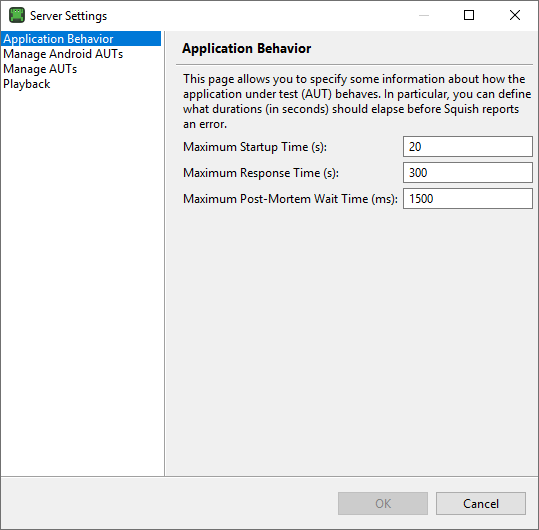
Application Behavior pane
In the Application Behavior pane, set Squish's timeouts for AUT startup, response, and post-mortem wait time.
You can set the response time also using the squishrunner's or squishserver's setResponseTimeout option. For more information, see Configuring squishrunner and Configuring squishserver).
Browser pane
In the Browser pane, set the browser to use for testing web applications.
Manage AUTs pane
In the Manage AUTs pane, manage the Mapped AUTs, AUT Paths, and Attachable AUTs that are registered with the squishserver. For more information, see AUT Paths and Mapped AUTs.
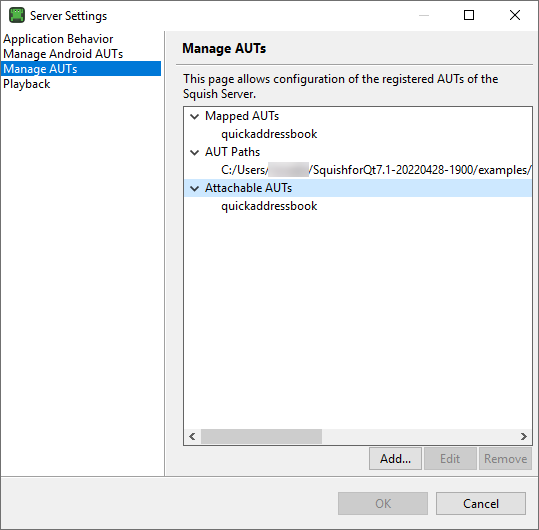
To remove the selected item, click the Remove button. To add a new mapped AUT, AUT path, or attachable AUT, first click the appropriate parent item (e.g., Mapped AUTs if you want to add a mapped AUT), and then click the Add button.
Click the Close button to save your changes and close the dialog.
You can also register and unregister AUTs by using Squish's command line tools, as instructed in AUT Paths and Mapped AUTs.
MCU Settings pane
In the MCU Settings pane, configure paths to MCU vendor tools used by Squish for MCU.
To open the pane, select Edit > Server Settings > MCU Settings.
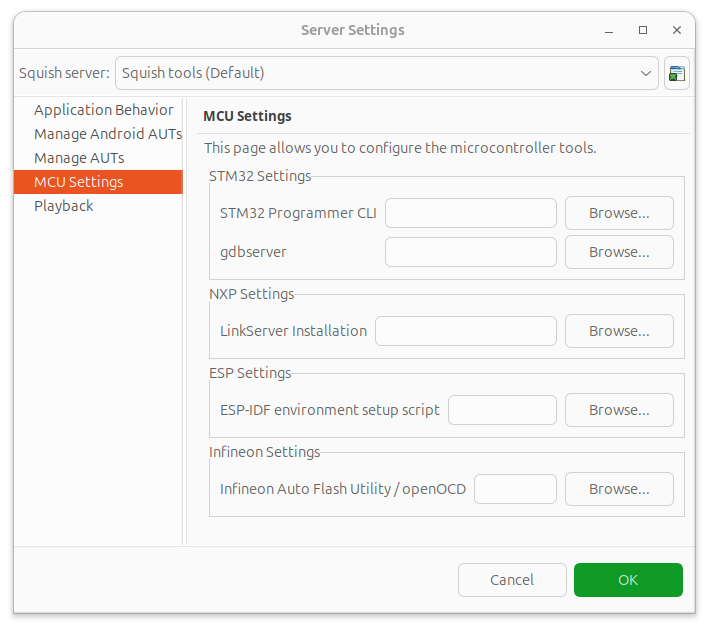
These tools are used for MCU-specific operations, such as flashing the AUT to the target device, resetting the AUT before test execution, or starting vendor-specific debug server workflows. Configure only the tools required for the MCU platform you are testing. Empty fields mean that the corresponding tool has not been configured.
The pane contains vendor-specific settings for STM32, NXP, ESP, and Infineon targets.
| Section | Setting | Description |
|---|---|---|
| STM32 Settings | STM32 Programmer CLI | Path to the STM32CubeProgrammer command-line executable. This is used for flashing STM32 targets. |
| STM32 Settings | gdbserver | Path to the ST-LINK GDB server executable. This is used for GDB/debug server workflows when required. |
| NXP Settings | LinkServer Installation | Path to the NXP LinkServer installation. |
| ESP Settings | ESP-IDF environment setup script | Path to the ESP-IDF environment setup script. |
| Infineon Settings | Infineon Auto Flash Utility / openOCD | Path to the Infineon Auto Flash Utility or openOCD executable. |
Note: The target configuration related to Infineon/openOCD can only be changed through a test crate and its jobinfo.json file.
For example, on Windows, the STM32 Programmer CLI path can look like this:
C:\Program Files\STMicroelectronics\STM32Cube\STM32CubeProgrammer\bin\STM32_Programmer_CLI.exeThe ST-LINK GDB server may be installed separately or as part of another STM32 tool package.
For information about configuring MCU tool paths with squishrunner or by editing qul.ini, see Updating locations of MCU tools and drivers.
Playback pane
In the Playback pane, select the Animate Mouse Cursor checkbox to animate the mouse cursor when replaying tests.
© 2025 The Qt Company Ltd.
Documentation contributions included herein are the copyrights of
their respective owners.
The documentation provided herein is licensed under the terms of the GNU Free Documentation License version 1.3 as published by the Free Software Foundation.
Qt and respective logos are trademarks of The Qt Company Ltd. in Finland and/or other countries worldwide. All other trademarks are property
of their respective owners.
