
How To Test Applications on MCUs
Overview
This guide explains how to set up automated testing for Qt Quick Ultralite (QUL) applications with Squish for MCU. It covers the setup flow for a Desktop AUT and highlights the additional steps required when testing on physical MCU hardware.
Follow the sections below when setting up automated testing for a new AUT. Use the jobinfo.json reference and Advanced MCU tool configuration sections for sophisticated use cases and additional configuration options.
Prerequisites
To automate testing of Qt Quick Ultralite (QUL) applications on microcontroller units (MCUs), the following software and hardware are required, with optional items clearly indicated:
- Squish Enterprise license
- Squish for MCU package for Linux or Windows
- Supported MCU board, optionally with a debug probe
- Serial/UART connection to the MCU board, or USB connection to the debug probe
- MCU vendor tools for the MCU board (optional)
To get the most out of image-based test automation, we recommend installing and configuring one of the supported OCR engines too.
Supported MCU target boards for automated testing
For an MCU board to support automated testing of QUL applications, Qt Quick Ultralite provides Device Link implementation for that specific hardware. Device Link is required to enable communication between the host and the device and Squish for MCU leverages it to:
- inject user input (e.g. touch events)
- capture screenshots for image-based verification
- exchange performance and logging data needed for debugging and test execution
To determine whether a particular board supports test automation with Squish for MCU, consult the official Qt for MCUs platform support documentation, which is the authoritative reference. For MCU platforms without Device Link implementation, Qt for MCUs step-by-step porting guide contains instructions on how to implement Device Link support yourself.
Connecting the Device
For basic device connectivity and image-based automated testing, a serial/UART connection is sufficient. However, with a raw UART connection, some convenience features provided by Squish for MCU, such as flashing the AUT onto the device and resetting the AUT to its initial state before a test begins, are not available. These operations rely on MCU vendor tools, and we recommend using them together with a debug probe and USB connection for reliable communication.
Note: Make sure that the serial/UART port used by Squish is not being used by another application, such as a terminal emulator or an MCU vendor programming tool. Usually, only one application can access the same serial port at a time.
Debug probes
Vendor-specific debug probes (e.g. an NXP board paired with an NXP probe) are preferable. As a third-party option, J-Link debug probes are supported, with some limitations for native debugger reset.
Installing MCU Vendor Tools
Installing MCU vendor tools is optional. Without these tools, however, some of the convenience features of Squish for MCU (notably flashing the AUT onto the MCU device and resetting the AUT) are not available. For testing with these features, only a subset of vendor tools is required rather than the full package as follows:
- LinkServer for MCUs (can be installed as part of MCUXpresso IDE)
- STM32CubeProgrammer command-line interface
- STM32CubeProgrammer GDB server
- Espressif IoT development framework
- openOCD / Infineon Auto Flash Utility
For an authoritative reference on the supported versions of these tools for each board, consult the Qt for MCUs list of prerequisites. The location of vendor tools on the PC can be set during Squish for MCU installation, and the installer also provides download links for convenience.
Configuring MCU Vendor Tool Paths
After Squish for MCU is installed, configure the MCU vendor tool paths in Squish IDE by going to "Edit > Server Settings > MCU Settings". For detailed information about configuring access to MCU vendor tools in the Squish IDE, see the MCU Settings pane.
Advanced configuration methods are described in Advanced MCU tool configuration.
Building the AUT with Device Link Enabled
Before Squish for MCU can control the AUT, the AUT must be built with Device Link enabled. For details, see Making your QUL AUT testable.
Packaging the Test Crate
A test crate is a .tar.gz archive that contains the files required to set up and run the AUT. The contents of the test crate depend on whether the AUT is built for a Desktop target or for a physical MCU target.
Create the test crate manually by packaging the required files described below into a .tar.gz archive. For a Desktop target, include all files required to run the application from the unpacked test crate. For example, on Windows, this may include additional DLLs if they are not already available through the system PATH. How these files are produced or provided depends on the toolchain and development environment used to build the AUT.
Setting up a Desktop AUT
A Desktop target is a Qt Quick Ultralite application built to run on a desktop platform. It can be used to create and record tests without a physical MCU device.
For Desktop targets, the AUT must be built as a Qt application with Device Link enabled. Since the Desktop target does not run on physical hardware, MCU vendor tools are not required.
The test crate must contain the Desktop AUT executable and a jobinfo.json file, and any additional files required to run the application.
For Desktop AUTs, these additional files can include Qt runtime dependencies, such as the QtCore, QtGui, or QtWidgets libraries, and the platform plugin for the target desktop platform, unless they are already available in the runtime environment.
For example, a jobinfo.json file for a Desktop AUT can look as follows:
{
    "deviceType": "qt",
    "elf": "awesome-aut.exe"
}
The elf field points to the AUT executable. On Windows, the executable usually has the .exe extension, while on Linux it typically has no file extension.
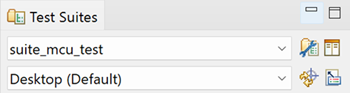
To set up the Desktop AUT in Squish IDE, create an MCU test suite and select Desktop (Default) from the device list.
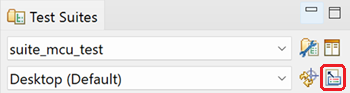
Click Flash MCU Device to open the Flash Device dialog.
In the Flash Device dialog, select the previously created test crate and click Flash.
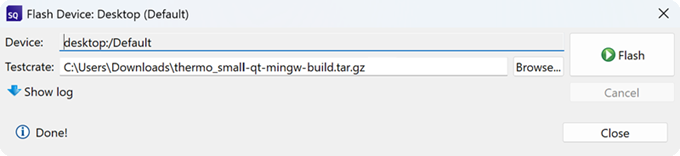
For a Desktop target, this step does not flash physical hardware. Instead, Squish registers the AUT so that it knows which application to start for Record and Replay. Squish also creates an internal cache associated with the AUT.
After this step completes, the Desktop AUT is ready to use with Record and Replay.
Note: If the AUT configuration or the jobinfo.json file changes, repeat the setup process with the updated test crate.
Test crate for MCU AUTs
For physical MCU targets, the test crate is expected to contain the following files:
- ELF file
- HEX file
jobinfo.json
The ELF/HEX file should represent the AUT that is flashed onto the device. Squish requires that the AUT is built with Device Link enabled. See Making your QUL AUT testable, otherwise Squish can not hooking up the AUT.
The jobinfo.json file specifies the information required for flashing and running the AUT on a particular device. Vendor-specific examples are available in jobinfo.json reference.
Flashing and Running the AUT
After the test crate is ready, create an MCU test suite in Squish IDE, select the target device from the device list, and click Flash MCU Device to select and flash the test crate.
After flashing completes, the AUT is ready for Record and Replay. For the Desktop AUT setup flow, see Setting up a Desktop AUT.
For a full walkthrough of creating and recording tests, see Creating a Test Suite.
Reference
Advanced MCU tool configuration
Updating MCU tools and drivers with squishrunner
You can also update the MCU tool paths with the squishrunner command. This approach requires a currently running squishserver process.
The current configuration can be viewed with the following command:
$ ./squishrunner --info mcuSettings
St-Link     Programmer      /usr/local/st/stm32cubeclt_1.18.0/STM32CubeProgrammer/bin/STM32_Programmer_CLI
St-Link     GDBServer       /usr/local/st/stm32cubeclt_1.18.0/STLink-gdb-server/bin/ST-LINK_gdbserver
NXP         LinkServer      /usr/local/LinkServer_25.7.33
Esp         EnvScriptPath   /usr/local/esp/esp-idf/export.sh
Infineon    FlashUtility    /usr/local/openocd-5.7.0.3672-linux/openocd
The configuration can be changed through squishrunner with the --config command.
$ ./squishrunner --config mcuSettings <vendor>:<tool>=<value>These vendor/tool settings are supported:
- St-Link:GDBServer
- St-Link:Programmer
- NXP:LinkServer
- Esp:EnvScriptPath
- Infineon:FlashUtility
For example:
$ ./squishrunner --config mcuSettings NXP:LinkServer=/usr/local/LinkServer_25.7.33Updating locations of MCU tools and drivers in qul.ini
You can edit the qul.ini file to update, add, or remove MCU tool paths. This file is located in the Squish User Settings ver1/ Directory.
The following is an example qul.ini file. On Windows, backslashes must be escaped with a preceding backslash.
[St-Link]
GDBServer=C:\\MCUTools\\STM\\STLink-gdb-server\\bin\\ST-LINK_gdbserver.exe
Programmer=C:\\MCUTools\\STM\\STM32CubeProgrammer\\bin\\STM32_Programmer_CLI.exe

[LinkServer]
InstallPath=C:\\MCUTools\\NXP\\LinkServer

[Esp]
EnvScriptPath=C:\\MCUTools\\Espressif\\frameworks\\esp-idf-v5.3.1\\export.bat

[Infineon]
FlashUtility=C:\\MCUTools\\Infineon\\Auto Flash Utility 1.4
jobinfo.json Reference
The LinkServer is NXP’s programming and debugging utility. It provides the communication layer between NXP debug probes (such as MCU-Link or LPC-Link2) and development tools like MCUXpresso for Visual Studio Code.
The JSON file contains the following fields: elf, hex, deviceBaudRate, deviceType, and flashInfo. The elf and hex fields contain the name of the AUT. The deviceType field defines the used hardware and the deviceBaudRate field sets the UART connection speed.
The following example jobinfo.json file uses LinkServer. This configuration is designed so that the AUT named awesome-aut can be flashed onto the NXP i.MX RT1050 Evaluation Kit. In this case, the flashInfo field contains the chipName, connectScript, and partInfoDirectory.
{
    "deviceBaudRate": 115200,
    "deviceType": "mimxrt1050-evk",
    "flashInfo": {
        "chipName": "MIMXRT1052xxxxB",
        "connectScript": "RT1050_connect.scp",
        "partInfoDirectory": "cmake"
    },
    "elf": "awesome-aut.elf",
    "hex": "awesome-aut.hex"
}
Supported device types:
- mimxrt1050-evk-baremetal
- mimxrt1050-evk-freertos
- mimxrt1060-evkb
- mimxrt1060-evkb-baremetal
- mimxrt1064-evk-baremetal
- mimxrt1064-evk-freertos
- mimxrt1170
- mimxrt1170-evkb-freertos
STM32CubeProgrammer is STMicroelectronics’ programming tool for STM32 devices.
Within the JSON file, the following fields are: elf, hex, deviceBaudRate, deviceType, and flashInfo. The elf and hex fields contain the name of the AUT. The deviceType defines the used hardware and the baud rate field sets the speed of the UART connection.
Below is an example of a jobinfo.json file that uses the STM32CubeProgrammer. This configuation is designed to so that the AUT with the named awesome-aut can be flashed onto the STM32H750B-DK Discovery kit. In this case, the flashInfo field contains only the externalLoader field.
{
    "deviceBaudRate": 115200,
    "deviceType": "stm32h750b-discovery",
    "flashInfo": {
        "externalLoader": "MT25TL01G_STM32H750B-DISCO.stldr"
    },
    "elf": "awesome-aut.elf",
    "hex": "awesome-aut.hex"
}
Supported device types:
- stm32f469i-discovery
- stm32f769i-discovery-baremetal
- stm32f769i-discovery-freertos
- stm32h750b-discovery
- stm32h750b-discovery-baremetal
ESP-IDF is Espressif’s official build system and development framework for ESP32-series microcontrollers. It provides the tools, libraries, and APIs needed to build, configure, and flash applications.
The most minimal JSON file specifies only one field: extra_esptool_args. Within this field, the chip of the target hardware is specified. ESP-IDF supports multiple chips and a full list of supported chips can be acquired by calling idf.py --list-targets.
{
    "extra_esptool_args": {
        "chip": "esp32s2"
    }
}
The following jobinfo.json is more advanced and allows for specific custom configs:
{
    "deviceBaudRate": 115200,
    "flasherInfo": {
        "write_flash_args": [
            "--flash_mode",
            "dio",
            "--flash_size",
            "16MB",
            "--flash_freq",
            "80m"
        ],
        "flash_settings": {
            "flash_mode": "dio",
            "flash_size": "16MB",
            "flash_freq": "80m"
        },
        "flash_files": {
            "0x0": "bootloader/bootloader.bin",
            "0x10000": "qt_for_mcus_app.bin",
            "0x8000": "partition_table/partition-table.bin"
        },
        "bootloader": {
            "offset": "0x0",
            "file": "bootloader/bootloader.bin",
            "encrypted": "false"
        },
        "app": {
            "offset": "0x10000",
            "file": "qt_for_mcus_app.bin",
            "encrypted": "false"
        },
        "partition-table": {
            "offset": "0x8000",
            "file": "partition_table/partition-table.bin",
            "encrypted": "false"
        },
        "extra_esptool_args": {
            "after": "hard_reset",
            "before": "default_reset",
            "stub": true,
            "chip": "esp32s3"
        }
    }
}
Infineon KitProg3 is a programming and debugging firmware used on Infineon development kits. It provides the communication layer between Infineon tools like ModusToolbox™ Programmer and the target device (for example, TRAVEO™ T2G Cluster 4M Lite Kit).
Within the JSON file, the following fields are: elf, hex, deviceBaudRate, deviceType and the flashInfo. The elf and hex fields contain the name of the AUT. The deviceType defines the used hardware and the baud rate field sets the speed of the UART connection. Note, this set baud rate can be overwritten from the IDE. Depending on the device, the flashInfo contains extra information that is required/needed during the flashing.
Below an example jobInfo.json is shown that uses the KitProg3. This config is designed to, so that the AUT with the name "awesome-aut" can be flashed onto the Infineon TRAVEO™ T2G Cluster 4M Lite board. In the case of Infineon, the flashInfo field contains the targetConfig. The target config ships with openOCD and can be found under the path "<openOCD root dir>/scripts/target/". The deviceType and targetConfig should refer to the same device!
{
    "deviceBaudRate": 115200,
    "deviceType": "tviic2d4mlite",
    "flashInfo": {
        "targetConfig": "traveo2_c2d_4m.cfg"
    },
    "elf": "awesome-aut.elf",
    "hex": "awesome-aut.hex"
}
Supported device types:
- tviic2d4m-baremetal
- tviic2d4mlite
- tviic2d4mlite-baremetal
- tviic2d6m-baremetal
- tviic2d6mlite
- tviic2d6mlite-baremetal
© 2025 The Qt Company Ltd.
Documentation contributions included herein are the copyrights of
their respective owners.
The documentation provided herein is licensed under the terms of the GNU Free Documentation License version 1.3 as published by the Free Software Foundation.
Qt and respective logos are trademarks of The Qt Company Ltd. in Finland and/or other countries worldwide. All other trademarks are property
of their respective owners.
